

How to use ChatGPT for your resume
without it sounding like ChatGPT
9 Minutes read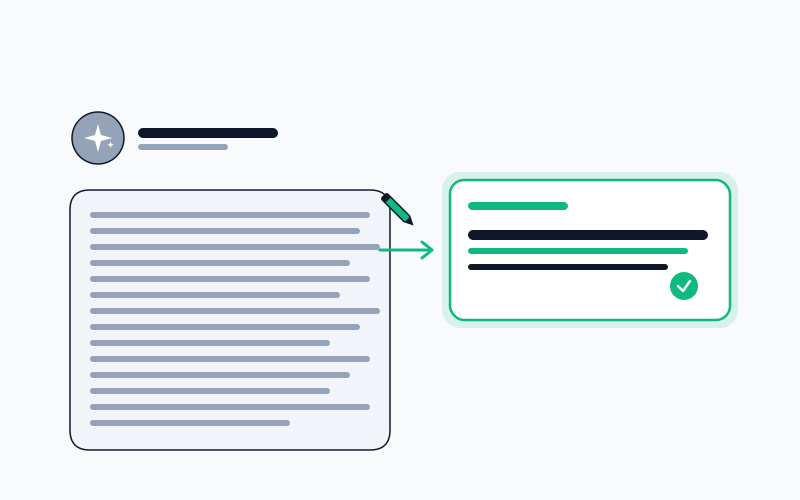
Recruiters can tell when a resume was written by AI. The fix isn't not using it: it's using it for specific tasks and editing out the tells.
Recruiters in 2026 can tell, usually within twenty seconds, which resumes were written by ChatGPT and submitted unedited. The tells are consistent. The phrasing is too smooth, too balanced, too positive. Every bullet hits the same rhythmic cadence. Every sentence ends with a neat little flourish. Reading a dozen of them in a row feels like reading twelve different versions of the same resume, because in a meaningful sense they are.
This isn't about whether you should use AI to help with your resume. You should. The interesting question is how to use it so that the output reads like you wrote a sharper-than-usual resume, not like ChatGPT wrote one for you. This is a working guide to doing that specifically.
The four things AI is genuinely good at for a resume
Start with what it's actually useful for. Not everything.
1. Turning messy bullets into clean ones. You have the raw material (what you actually did) but you're bad at compressing it into a crisp bullet. AI is excellent at this. "I worked on a migration thing where we moved from one database to another and it went well and I was the lead" becomes "Led the migration of four services from Postgres to DynamoDB over 10 weeks, with zero data-loss incidents."
2. Suggesting stronger verbs for weak ones. You wrote "worked on" five times. AI will give you thirty better options. Then you pick three that are honest.
3. Tailoring per JD. Given your full CV and a target JD, AI is genuinely useful at suggesting which bullets to lead with, which skills to emphasize, and which summary sentence variant to use. This is the highest-leverage AI use for resumes.
4. Proofreading and consistency checking. Tense mismatches, date format inconsistencies, stray passive-voice sentences. AI catches these fast.
That's the list. Everything past this point (having AI write your summary from scratch, generating bullets for work you didn't do, extrapolating outcomes you can't verify) is where the output goes wrong.
The four tells that mark AI-written resumes
If you use ChatGPT output unedited, these are the patterns a recruiter is pattern-matching against.
Tell 1: The rhythm is too uniform
AI-generated bullets tend to have the same cadence: roughly the same length, the same sentence structure, the same rhetorical rhythm. A human-written resume has variation: some bullets are short and punchy, some are long and specific, some start with the action, some with the scope.
Example of the AI rhythm:
- Spearheaded the development of a scalable billing platform, resulting in improved system performance and reduced operational costs.
- Led cross-functional collaboration with product and engineering teams, delivering high-impact features on schedule.
- Implemented comprehensive monitoring solutions, significantly enhancing system reliability and reducing incident response times.
Every bullet is the same length. Every one has the same verb-clause-outcome structure. Every one ends on a positive abstract outcome. This is the signature.
A human-edited version would look more like:
- Built the billing platform from scratch; now handles 40M events/day.
- Led the Kafka migration (4 services, 8 weeks, zero regressions).
- Cut infra spend 23% via rightsizing (ongoing, not a one-time fix).
- Mentored 3 engineers; two promoted, one left for a staff role elsewhere.
Different lengths, different structures, different rhythms. Mix of outcomes (some quantified, some descriptive, some ongoing/messy). Fewer adjectives per line. Reads like a person.
Tell 2: Adjective inflation
AI loves modifiers. Every system is "scalable," every collaboration is "cross-functional," every result is "significant" or "impactful" or "transformative." Read any AI-generated resume bullet and count the adjectives: there are usually 2-3 per sentence.
A well-written human resume, paradoxically, has fewer adjectives per line. The specifics do the work. "Reduced p99 from 800ms to 120ms" doesn't need "significantly" in front of it. The numbers already tell you it's significant.
Rule: if cutting an adjective doesn't change the meaning, cut it. Applied to AI output, this usually halves the word count and doubles the signal.
Tell 3: Everything is a win
AI-generated resumes read as uniformly triumphant. Every project succeeded. Every initiative was impactful. Every migration was flawless.
Real careers don't look like that. Real careers have projects that worked, projects that were hard, projects that were compromises, skills the person is still growing into.
Human-edited resumes sometimes include honest texture:
- "Led the migration; initial rollout caused a 2-hour outage that we fully postmortemmed and fixed permanently."
- "Managed 3 ICs, including one underperformer I transitioned out."
- "Shipped the feature; the lift was smaller than projected (8% vs forecasted 15%) but the customer retention impact was material."
This kind of honest specificity is what AI mostly doesn't produce by default. It makes bullets more memorable and credible.
Tell 4: Buzzword soup
AI trained on thousands of resumes has absorbed the full lexicon of resume clichés, and reproduces them reliably. Drove, delivered, spearheaded, orchestrated, leveraged, optimized, streamlined, facilitated, championed, empowered. These verbs are not wrong. They're just every other AI-generated resume.
A real human resume has more boring verbs that happen to be more specific: built, shipped, wrote, ran, decided, rewrote, killed, cut, grew, hired, fired, launched. They sound less impressive in isolation, which is precisely why they sound more credible in context. For a closer look at which verbs actually earn their keep on a resume, see resume action verbs: most lists are wrong.
The workflow that produces human-sounding output
Given all that, here's a workflow that uses AI effectively without producing tell-ridden output.
Step 1: Write your raw bullets yourself, bad.
Start with a braindump. Every role, every project, every outcome. Messy, colloquial, bad prose. "Did the database migration. Took like two months. Nobody complained afterward. Cost was about 30% less."
This is the raw material. Don't polish it. Don't skip it. The raw version is the most honest version of what you did, and it's what AI needs as input.
Step 2: Use AI to compress, not to invent.
Feed the raw bullet to ChatGPT with: "Rewrite this as a single crisp resume bullet. Do not invent details. Use only information I've given you."
The output will still need editing, but it'll be in the right neighborhood. Critically, you're constraining it to facts you already specified, not letting it extrapolate.
Step 3: Vary the rhythm manually.
Look at the output bullets as a group. If they all have the same length or structure, change some. Break patterns. Short bullets. Long bullets with specifics. Bullets that start with the scope; bullets that start with the verb. Variation reads as human.
Step 4: Cut half the adjectives.
Pass through and delete. "Significantly reduced" becomes "reduced." "Successfully launched" becomes "launched." "Comprehensive monitoring" becomes "monitoring." Almost always, the meaning stays the same and the bullet gets tighter.
Step 5: Add one honest texture.
Pick one or two bullets across your resume and add specific texture that isn't pure win: the outage that was postmortemmed, the project that took longer than expected, the tradeoff you lived with. This asymmetry is one of the strongest human-sounding moves available.
Step 6: Read the output aloud.
This catches 80% of remaining AI-tells. If you read a bullet out loud and it sounds like something you'd say in a conversation, keep it. If it sounds like marketing copy, rewrite. Your speaking voice is more specific than your writing voice, and resumes benefit from matching it.
A worked example
Raw (what you'd tell a friend):
Did the Kafka thing over last year. We moved from rabbit to Kafka because of scale problems. Took me and two other folks, like 10 weeks total. Rollout had one hiccup but no data loss. Now we run like 5x the throughput.
ChatGPT output (unedited, bad):
Spearheaded the strategic migration from RabbitMQ to Apache Kafka over a 10-week period, collaborating with a cross-functional team to address scalability challenges and drive significant improvements in system throughput, resulting in a 5x increase in performance with minimal disruption to production systems.
Edited version (human-sounding):
Led the RabbitMQ → Kafka migration (10 weeks, 2 other ICs). One rollout hiccup, no data loss. Throughput now 5× the old ceiling.
The edited version: shorter, specific numbers, honest texture (the hiccup), no resume clichés. Same facts. Different register.
The tailoring question
AI is genuinely useful for per-JD tailoring because the mechanical work of adjusting a bullet order or swapping a summary sentence is exactly the kind of thing it's good at.
Good tailoring prompt pattern:
Here's my CV [paste]. Here's a JD [paste]. Suggest 3 specific changes (which bullet to move up in my current role, which skill to add or remove, and a one-line summary tweak) to make this CV land better against this JD. Don't invent new bullets; only reorder or adjust existing ones.
The constraint "don't invent new bullets; only reorder or adjust" is load-bearing. It keeps the output honest.
The cover letter note
Everything above applies even more strongly to cover letters, with one specific twist: the cover letter's whole job is to include the sentence AI cannot write, the specific reference to the company, the team, or the product that proves you've paid attention.
A cover letter that's 100% AI-generated has, by construction, zero of those sentences. It'll read as generic because it is.
Use AI for the body-structure scaffolding of a cover letter. Handwrite the one or two sentences that name the specific thing you noticed about the company. Those sentences are the entire point.
The meta-frame
The skill isn't "not using AI." It's using AI for the parts where it genuinely saves time (compression, tailoring, proofreading) and doing the parts that matter (voice, specificity, honest texture) yourself.
When you do it well, the resume reads sharper than you'd write alone and more human than AI would produce alone. That combination (leverage on the mechanical work, judgment on the editorial choices) is what actually wins in 2026. Not AI purism, not AI dependence. The specific blend.
Jobiz exists to run that workflow consistently, application after application: compress against the JD, vary the rhythm, hold the line on no-invented-facts, drop the adjective inflation. Done from a master resume you keep current, against each posting, in the same pass. Your time goes to the editorial layer (which proof points to lead with, which texture to add, which sentence opens the letter) instead of to repeating the same prompt routine in ChatGPT for every application. Those are the parts that actually decide outcomes.
No spam. Unsubscribe anytime.
Related Articles
The recruiter screen: what the first call is really checking
The first call is short, but it filters more candidates than any other stage. What the recruiter is listening for, and how to answer the money question.
 Jobiz Team
Your employer made a counter-offer. Should you take it?
A counter-offer fixes the number, rarely the reason you looked. How to weigh one honestly, and how to turn it down without burning the bridge.
Jobiz Team
Take-home assignments: how much unpaid work is too much?
A fair take-home is a few hours, scoped, and reviewed by a person. How to tell a reasonable one from free consulting, and what to say when it isn't.
Jobiz Team