

The three-line resume summary
that doesn't get skipped
9 Minutes read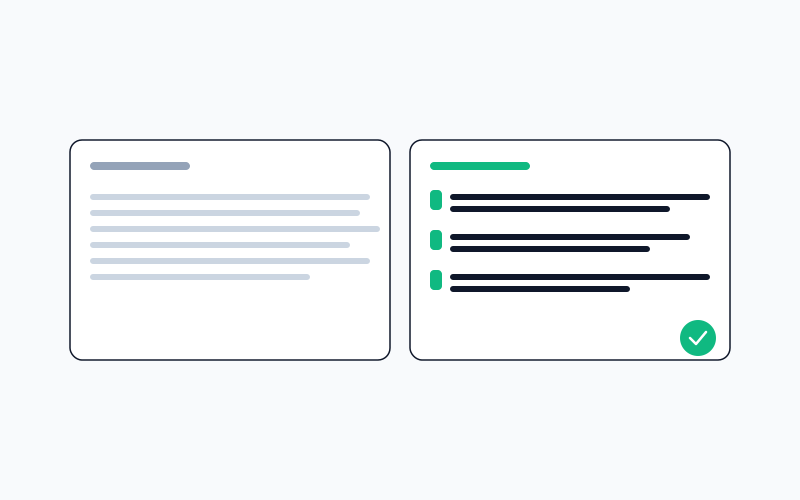
Most resume summaries are skipped in the six-second scan. Here's the specific structure that earns attention, with weak vs strong examples across seniority.
Recruiters admit, when they're being candid, that they skip the summary on most resumes. It's usually a hedge-everything paragraph that could apply to any candidate in the same role. They skim to the experience section, which is where they expect the actual information to be.
The summary is skipped because most summaries deserve to be skipped. They say nothing. They exist because the candidate was told to include one. They take up four lines of prime real estate at the top of the page and produce zero signal.
A strong summary is different. It's three sentences that make the person on the other side of the table decide, consciously or not, this resume is worth reading carefully. It earns the scan. This is how.
Why most summaries fail
Pull up a random resume. Read the summary. You'll see one of these patterns:
"Passionate software engineer with 8+ years of experience in building scalable web applications and leading cross-functional teams. Proven track record of delivering high-quality solutions. Excited to contribute to innovative teams."
Every word here is generic. Passionate, scalable, proven track record, high-quality, cross-functional, innovative. This sentence could describe 500,000 engineers. It tells the reader nothing they couldn't assume from the job title alone.
The failure mode is trying to sound like a resume. A summary written to sound like a summary reads as generic because every candidate is doing the same thing. Your summary should sound like you're explaining who you are to one specific person, at this one specific company, in the simplest words that still happen to be true.
The three elements of a summary that works
A good resume summary contains three elements, in order:
- Anchor: who you are right now, in concrete terms (role, years of experience, specific function, NOT adjectives).
- Proof: one specific thing (a project, an outcome, a scope) that would be impressive to this role's hiring manager.
- Direction: what you want next, or what you're currently focused on, that makes this role make sense.
Two to three sentences total, 40 to 70 words. If you're going over 70 words, you're hedging.
Example: senior engineer
Weak:
Senior software engineer with 8+ years of experience building web applications at startups and enterprises. Passionate about clean code, mentorship, and continuous learning.
Strong:
Senior backend engineer, 8 years at B2B SaaS companies. Led the migration of Acme's billing service from monolith to event-driven (40M daily writes, 99.95% uptime). Currently looking for a staff+ role at a systems-focused company where the infrastructure decisions haven't all been made.
What changed: the anchor got specific ("backend engineer, B2B SaaS"). The proof is a concrete project with numbers. The direction is pointed: "staff+ role, systems-focused company, decisions not all made yet." Every sentence carries information. Forty-eight words.
Example: senior PM
Weak:
Results-driven product manager with 6+ years of experience in SaaS. Skilled at driving roadmap strategy, leading cross-functional teams, and delivering data-informed products.
Strong:
Senior product manager, 6 years in B2B SaaS, focused on pricing and monetization. At Widget Corp, shipped usage-based pricing that became 60% of new ARR in four quarters. Looking for a senior+ role owning the same surface area at an earlier-stage company.
Same three moves. Anchor is concrete (domain + focus area). Proof is a single specific project with an outcome. Direction connects to the role.
Example: designer
Weak:
Creative and detail-oriented product designer with 5 years of experience designing user-centered digital experiences. Passionate about accessibility and design systems.
Strong:
Product designer, 5 years shipping consumer mobile at Acme. Most recently led the checkout redesign that cut drop-off by 22%. Comfortable owning flows end-to-end; weakest in brand-identity work. Looking for a senior product designer role on a consumer team with real engineering partnership.
Specific role type. Specific recent project with outcome. Unusually, a weakness: this is fine at senior levels and reads as self-aware. Direction says exactly what kind of team.
Example: career-changer
This is where summaries have to work hardest.
Weak:
Former teacher transitioning into UX design. Passionate about user-centered thinking and eager to apply my transferable skills in a new industry.
Strong:
UX designer transitioning from 6 years in K-12 education. Completed the Designlab UX Academy in 2024; since then, shipped two end-to-end projects (portfolio link). Looking for a junior product designer role on a team with strong design mentorship.
Specific frame of the pivot. Specific training and proof of work. Specific target for the next step. A hiring manager reading this knows exactly what they're looking at within five seconds.
Example: early career
Weak:
Recent computer science graduate passionate about building impactful software. Eager to learn from experienced engineers and contribute to meaningful products.
Strong:
Recent CS graduate (Carnegie Mellon, 2025). Two internships at infrastructure-adjacent companies; open-source contribution to [specific project] merged last year. Looking for a junior backend role on a team with strong code-review culture.
Concrete specifics even at junior level: a specific school year, two specific internships, a specific open-source project, a specific kind of team. Every one of these is a handle the recruiter can pull on.
What the strong examples share
All of the strong versions above have three things the weak ones lack:
Specificity in the anchor. Not "engineer" but "backend engineer at B2B SaaS companies." The more specific the anchor, the less generic the rest of the summary has to work to avoid sounding like.
One concrete proof point with numbers or named context. Not "delivered high-quality solutions" but a specific project, a specific customer, a specific outcome. Numbers are strong. Proper nouns are strong. Vague adjectives are weak.
A direction statement that makes this role the next logical step. Not "looking for new challenges" but something specific enough that the hiring manager reads it and thinks oh, that's us. The direction is what tailors the summary per application.
The words to cut
A list you can search your current summary for. If any of these appear, there's a good chance the summary is weaker than it should be:
- Passionate
- Results-driven
- Detail-oriented
- Proven track record
- High-quality
- Scalable (unless paired with a number)
- Innovative
- Dynamic
- Creative (unless job-specific and earned)
- Cross-functional (used without specifics)
- Strong communicator
- Eager to learn
None of these add information. They're filler that makes the summary longer without making it more memorable. The test: if you cut the word, does the meaning change? If no, cut. The same principle applies to bullets. See resume action verbs: most lists are wrong.
Tailoring the summary per application
The summary is the most per-application-variable section of the resume. The anchor and proof don't change much (your facts don't change). The direction statement does, and probably the proof example you lead with does too.
If you're applying to two different kinds of roles, your summary should have two variants:
Role A, infrastructure: leads with the systems/infra proof, direction says "infrastructure-focused."
Role B, product feature work: leads with a product-feature proof, direction says "product engineering role with engineering partnership."
Same underlying facts. Different emphasis. Same candidate, different story for each role.
This is genuinely hard to do manually across many applications. It's also the single most impactful per-role customization you can do. Every other change to the resume (reordering bullets, adjusting skills) is smaller than rewriting the summary for fit. For the mechanics of how the rest of the tailoring pass works, see CV tailoring: what actually changes from one application to the next.
What to do if you can't write a strong proof point
Sometimes candidates read the "include a concrete proof" advice and realize they don't have one, either because their current role hasn't produced a specific named outcome, or because they can't describe one without violating confidentiality.
Options, in order of preference:
- Lead with scope instead of outcome. "Owner of the billing service (40M events/day, 8-person team)" is a proof point even without a specific outcome.
- Use a scope change as proof. "Promoted from senior to staff in 2024; expanded ownership from one service to three."
- Use an anonymized but specific outcome. "Reduced service latency by ~60% through architecture changes" doesn't need to name the service if confidentiality matters.
- Use a recent concrete project. "Most recently shipped [project]; currently owning [thing]."
The only bad option is abstract platitudes. Anything concrete beats nothing concrete.
The summary vs. the cover letter
Candidates sometimes confuse the summary with a cover letter. They're different.
The summary is three sentences, always visible, in the resume. It has to be true and broadly applicable to the role.
The cover letter is a fuller pitch, included when submitting, tailored per application, can make arguments the resume can't.
Don't try to make the summary do what the cover letter does (detailed arguments, narrative). Don't try to make the cover letter do what the summary does (concise positioning). They're different tools for different moments in the reader's scan.
The closing frame
Most candidates put the least amount of effort into the part of the resume that's read first. That inversion is why most summaries are skipped.
Three sentences. Specific anchor, one concrete proof, clear direction. Cut every adjective that doesn't carry load. Tailor the direction per application.
Do that, and your summary stops being skipped, which means the rest of your resume gets the careful read it needs.
If rewriting the summary per role is where the tailoring time goes, Jobiz handles that adjustment so each application ships with a summary that fits, without you starting from a blank line every time.
No spam. Unsubscribe anytime.
Related Articles
The recruiter screen: what the first call is really checking
The first call is short, but it filters more candidates than any other stage. What the recruiter is listening for, and how to answer the money question.
 Jobiz Team

Your employer made a counter-offer. Should you take it?
A counter-offer fixes the number, rarely the reason you looked. How to weigh one honestly, and how to turn it down without burning the bridge.
Jobiz Team
Take-home assignments: how much unpaid work is too much?
A fair take-home is a few hours, scoped, and reviewed by a person. How to tell a reasonable one from free consulting, and what to say when it isn't.
Jobiz Team